Guided practice – navigating the path from novice to expert in the English Literature classroom

As experts in our subjects, it’s easy for us to overlook the processes which novices must undertake in order to get to the desired end goal. After returning from online learning last year, my team’s focus has been on improving our use of guided practice, the main element of face-to-face teaching we felt our pupils had missed-out on.

Why should we be talking about guided practice?

Increase fluency:
The main aim of guided practice is to create fluency (or make new processes automatic). As suggested by Barak Rosenshine’s research, showing pupils new information, or even modelling new processes to them, does not ensure a secure understanding. In order for pupils to transfer new processes from their short term memory into their long term memory, they must practice the process themselves over an extended period of time.

Increase independence:
Using guided practice also increases pupil independence by setting them up for success when completing longer tasks by themselves. Practice makes permanent, so the more practice we guide our pupils through, the better.

Success = motivation:
With guided practice, pupils have increased opportunities to be successful. Even, and especially, when the new process is difficult, the teacher is there with them, talking them through the next step and catching misconceptions before they can become embedded. The feeling of success felt by pupils is what makes them intrinsically motivated to continue their learning journey. Rosenshine writes, in his Principles of Instruction, that, ‘Teachers who spent more time in guided practice and had higher success rates also had students who were more engaged during individual work at their desks.’ Success breeds motivation, and that evidence seems as good a reason as any to buy-in to the concept of guided practice.

What is guided practice?

Guided practice is the stage between showing pupils a model, and directing them to complete a task independently. It is a teacher-led transitional phase where you want to be leading pupils through the task step-by-step, thereby reducing their cognitive load and being able to quickly address misconceptions.

The ‘I do, we do, you do’ approach to gradually reducing support for pupils is a really helpful idea, but in my experience it is often applied as a linear process and used to simplify what is a complex part of teaching. Guided practice is a non-linear phase. It can’t be done just once and isn’t a tick-box lesson element. It’s something we want to use for lots of separate new tasks, repeatedly, over a long period of time.

In this excellent blog from 2018, Harry Fletcher-Wood directs us to think about all those who are somewhere in between on the novice-expert continuum when he writes, “Experts and novices think differently – and those who are no longer novices but not yet experts think differently again.” 

Novices are those new to a topic or task, who may know isolated pieces of information but whose wider knowledge of this area is lacking and therefore can’t make connections. If they try to do a new task independently, they will be at high risk of failure. We should not be directing novice pupils to just ‘have a go’ at a new task, because they will be unsuccessful and therefore less motivated to try it again.

Conversely, experts are those who are knowledgeable about the content of a topic and have practiced it multiple times, successfully. When they come across new pieces of information, they can fit them into what they already know, developing their schema. Schema are ways in which your brain organises information. Many of the thinking processes which experts go through are now subconscious.

What’s really important to be aware of is that there’s a lot of space on this continuum between novice and expert. And as Harry writes, those intermediates ‘think differently again’. Intermediates start to make connections between things, they start to develop those schema, those ways of organising their thoughts, but they are so at risk of failure and that makes them less motivated to try again. When planning lessons, we must remember that assumed knowledge is dangerous; we are, on a daily basis, at risk of alienating our pupils if we move too quickly to see them as experts and don’t guide them through this intermediate phase.

This example applied to knowledge of Lady Macbeth represents the difficulties which novices have observing and making links which experts make with ease:

How can guided practice be used in the English Literature classroom?

In our department we’ve broken our approach down into 6 steps.

1. Separate content and processes

As teachers, we must separate content and processes in the guided practice part of analysing literature.

Content is retrievable knowledge which must be secure (already in pupil’s long term memory) . If a pupil tries to hold new content in their working memory whilst trying to apply a new process, they will experience high cognitive load. Secure content knowledge relies on effective use of retrieval practice, for which I recommend the work of Kate Jones and Chris Curtis.

For example, pupils already need to know that Lady Macbeth obsesses over washing hands, and know that blood on hands is an image synonymous with guilt, before we can ask pupils to write an analytical para about Lady Macbeth’s guilt.

Other examples of content and processes include:

ContentProcess
– Plot
– Character
– Quotations
– Word meanings
– Allusions

E.g. Recalling

Lady M. says, ‘Out, damned spot!’
She is referring to blood on hands.
Blood is synonymous with guilt.
– Identify methods
– Analyse effect on reader/audience
– Link moment to whole-text structure
– Construct a paragraph/essay

E.g. Responding to a Q
Lady M. refers to the motif of blood when she says, ‘Out, damned spot,’revealing her admission of guilt to the audience.

2. Identify implicit processes

The step that often seems to get missed within the ‘we’ section of ‘I do, you do, we do’ is the teacher articulating how and why they know what to do next. During guided practice, we have to try to strip back our thinking processes to the point a novice can follow them. That’s really difficult.

In selecting which implicit processes we need to articulate, it’s important to pool ideas with our colleagues about those pupils seem to find tricky. Things we’ve found useful for this are cross-subject lesson drop-ins and coaching. Sometimes it’s easier to see if an implicit process hasn’t been articulated clearly if you’re a non-subject specialist.

Examples of processes which can be articulated during guided practice in the Literature classroom are those where pupils have to apply their content knowledge, including:

  • Identify key word in question
  • Select methods in quotation
  • Analyse effect on reader/audience
  • Link moment to whole-text structure
  • Make connections between author’s purpose and context
  • Construct a paragraph/essay
  • Choose appropriate verbs to show nature of author’s action

3. Script processes

Once you have identified those implicit processes, it’s so important to take time to break down what you do fluently into each separate part so that a novice can track your steps. This is also something best done collaboratively with a colleague so you can challenge each other’s thinking process.

If you don’t script the steps to use in your guided practice sessions, you will inevitably skip a step which you do subconsciously and this will result in losing some of your most novice pupils.

After using your script aloud for the same process a few times, you will – no doubt – begin to narrate these steps automatically. But, in the meantime, stick to your script.

I might plan a script for the process of choosing appropriate verbs to show the nature of the author’s action. The pupils have their own lists of academic adverbs and verbs which I and they will refer to during this process. I will write this in advance, practice it myself aloud, and then read from this as I write under the visualiser to complete my model.
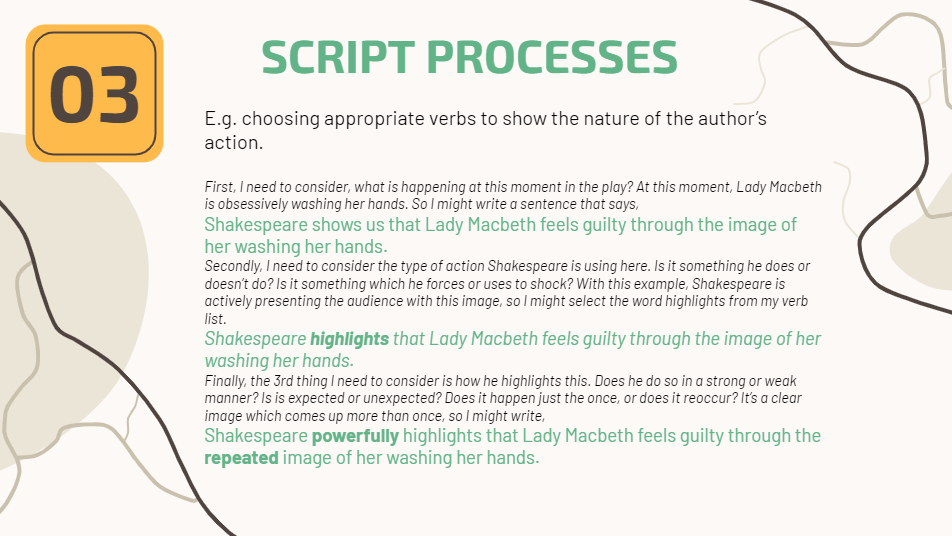
Having done this once as a model, I will do this again, this time with the pupils contributing to upgrading the verb choices, and again with them writing on mini-whiteboards, again in books, and so forth. It’s only one tiny process with three main steps but by articulating the steps which I go through again and again in the same format, pupils will start to develop fluency.

4. Provide scaffolds

Scaffolds are tools which support pupils to complete a task. They include physical resources but also, and more helpfully, frameworks which pupils can use to organise their knowledge.

Common choices might include sentence starters or gap fill activities. However, these don’t guide the pupils through the full thinking process they will later be expected to do independently.

We’ve moved to use of scaffolds that support pupils to identify the implicit processes themselves as they move through the implicit stage. Examples of this include a sheet which includes the building blocks of critical statements, which we call our ‘create a critical argument’ sheet. This is where they would find examples of adverbs and verbs as I previously referred to in my example script.

By guiding pupils step by step through these processes, we can support them to make connections across their schema, applying content through the processes to produce desired outcomes.

We have also found the use of the ‘What? How? Why?’ framework a helpful scaffold, both for questioning and guiding writing. Andy – who tweets @_codexterous – has written an excellent blog post which is really useful if you would like to try using these types of questions in your own classroom or department.

5. Chunk practice

In order to increase the success rate for pupils, and maintain pace, we ideally want to use guided practice for a short time focusing on a small, isolated process or element of a process. Chunking helps us to reinforce individual steps which can be put together later on, once they are automatic, to reduce cognitive load.

This can feel trickier in English than many other subjects; we’ve learnt a lot from other departments about how to do this more effectively, particularly maths and languages, and it remains a focus for us.

6. Use flexibly

In a video created for the Teach First ECF programme, Claire Stoneman says, ‘There is no one size fits all solution’ to guided practice. It isn’t something to just be used within one lesson one time; it should be used repeatedly for the same processes over and over.

It’s important to remember that our pupils will be novices in many different domains, even if they are experts in others. A pupil’s journey from novice to expert won’t be linear. Sometimes pupils will return to the novice stage if they are out of practice and we have to guide them along the path towards intermediate again. That’s okay and to be expected.

We as teachers need to use our professional judgement and feedback from pupil work to assess their current position on the pathway to help them make their next steps.

This is an approach which we think can be mapped onto a whole curriculum or onto a shorter sequence of lessons, and which works for English Language as well as Literature. Creating and refining these 6 steps has been a real process for us and it remains something we’re working on, so feedback is certainly welcome!

For a leader to be effective, do they need to care less?

In the past 18 months, I’ve done a lot of reflecting about my own middle leadership experience.

In April 2020, after the most surreal week of my – and many people’s – life ended with sending every pupil in our school home for the indefinite future as part of a nationwide lockdown, and we switched to two weeks of online teaching over a weekend, the Easter ‘holidays’ arrived. Instead of the planned residential with our GCSE pupils, two long weeks of nothingness stretched ahead. Part of me was excited at the prospect of sitting in the sun, finally getting through some of my TBR pile and spending time with a new puppy. But another part of me was full of worry.

In week 2 of online teaching, my headteacher had emailed around a quick questionnaire to check how staff were feeling. One question asked:

When you think about school, what is the thing that is concerning you the most at the moment?

I was, and still am, the English Curriculum Director. Upon reflection, the first things to come to my mind should have been:
– How we should deliver our full curriculum offer online.
– How we might monitor pupils’ progress.
– How we could support pupils to have access to reading material.
– How we would be required to give GCSE and A-Level grades.
– How the English Department would cope with balancing their work and family lives.

But I wrote, without hesitation:
I’m worried about how my Year 11 pupils will cope.

Not with their work, but with their lives, their families, their emotions. Why? Because I cared about them. As a year group. As individuals. They were the first Year 11 form I’d been a tutor for, and I had taught almost every one of them English. They were stubborn, moody, and never joined in when I sang them happy birthday, but they were also hilarious, adorable, and now left to navigate this uncertain world without the consistency which school provides. They were missing out on the final trip away with their peers, on the final push to exams, on the celebration of their hard work. What would they do without the routine and support of our school? How would they manage?

Worrying about pupils was not my job. Whilst our school ethos is founded on building strong relationships, my remote role did not require me to do anything beyond calling an allocated few pupils per week to check-in with their wellbeing and work output. Our school has a wonderful pastoral team and our SLT were actioning carefully-considered plans which would effectively support our whole pupil body. In the lull of the Easter break and still feeling anxious about them, for the first time since I began teaching, I wondered whether, in order to be an effective leader, it was necessary for me to care less about pupils as individuals.

Rationally, I know that investing too much time or emotion in the young people I teach would be a poor call. A school only functions properly if each individual executes their own role well, and I certainly have plenty else to be overseeing. However, the reality is that we’re all human, and when pupils (and people in general) come to me with a worry or a problem, I feel their pain and want to fix it. Even in the past few terms, amongst the madness of TAGs and bubbles bursting, beyond my expected safeguarding responsibility, I’ve prioritised lengthy coaching meetings about mental health, research into support organisations, re-reading personal statements and just having a catch-up about how the weekend went, with pupils I don’t spend any classroom-time with. Not because I want to be a martyr, but because I am genuinely invested in those young people flourishing in all aspects of their lives and becoming successful future adults.

Over a year on, and with a clear holiday mind, I have realised and chosen to accept that:

– I will continue to carry the tension between being effective in my curriculum role and caring about pupils on a daily basis. I can’t resolve the conflict, but I can strive for balance.
– I must have clearer boundaries which allow me to focus on certain roles at certain times.
– I should heed the – recently revisited – guidance of Brené Brown when my care for a pupil starts to overwhelm my capacity to do my job: ‘If their issues become yours, you now have two people stuck in a hole’. Unhelpful for all involved.

It would be great to be a super efficient leader, and I’ll keep trying, but I reckon the day I stop caring will be the day I choose to leave the profession, and I truly hope that will never happen.

How can we teach pupils to meaningfully analyse structure?

So often, in the English classroom, we spend a disproportionate amount of time talking about the language within texts. From KS2 upwards, we teach pupils the vocabulary to identify increasingly complex techniques within small extracts and quotations, from word types to assonance, zoomorphism and beyond. To combat feature-spotting approaches, we then teach pupils how to zoom-in for close word analysis and the go-to general effects of such techniques.

But can we all confidently say we dedicate equal time and thought to the structure of texts? Are your pupils able to comment as effectively on the writer’s choices in their composition of extracts and whole texts? The GCSE examiner reports suggest not. Whilst you may not agree that exam boards are the best measure of pupil learning, it’s difficult to ignore the common trends they are able to observe across the five hundred thousand pupils who sit English Language and Literature GCSEs each year.

Different exam boards do require differing approaches to structure. In Language Paper 1, whilst Edexcel and OCR bring together language and structure in one question, followed by an evaluative question for which either could be commented on, AQA separate out the two, emphasising the need to comment on whole text direction as opposed to smaller techniques. Regardless of their phrasing of questions, all of the exam boards recognise the importance of focusing on structure in both the Language and Literature papers. Some recent examiner reports include the following:

This image has an empty alt attribute; its file name is image-2.png
This image has an empty alt attribute; its file name is image-1.png

The main takeaways are things which I’m sure will be familiar to you all:

  • Pupils need to see texts as constructs, the crafted creations of writers.
  • Pupils need to understand that methods include bigger, whole-text choices of development and change, not just those at word-level.
  • If pupils are taught to spot smaller structural features such as short sentences in order to answer a GCSE Language exam question, it should come as no surprise that they will do the same when analysing their Literature texts in essay answers. They must be taught to appreciate whole-text choices.

Recognising the need to teach pupils to appreciate structure is one thing, but how do we do it? Attempts to answer this force us to consider an even bigger question: what is structure? Structure refers to the putting together of multiple parts; it is the make-up of something; a construct. There are a number of ways in which we can draw pupils’ attention to the structure of texts and get them thinking about its importance, long before teaching them to answer a question on a GCSE paper.

1) Separate text direction & structural techniques:

First up is to separate the text direction and smaller structural techniques. It’s difficult for our pupils to follow our direction if we use the same word – structure – to describe multiple methods. Agreeing on a shared language is important. The phrase ‘text direction’ helps to guide pupils through an active reading process; leading them to comment on which events take place in what order. ‘Structural techniques’, on the other hand, are more specific methods used WITHIN the text’s direction, for example, dialogue or sentence lengths.

Moving between these 2 regularly, toggling between zooming-in and zooming back out again, is something we should be modelling to our pupils and giving them time to practise. One really practical way to introduce this approach to your pupils is through the use of short video clips, watching once to identify the text direction (i.e. what’s happening) and watching again to pick out smaller structural features like camera angles for a shift in perspective.

2) Normalise interrogating the text:

Method number 2 is to normalise the interrogating of texts. This is all about questions. Whatever age or stage your pupils are at right now, they will benefit from being encouraged to ask questions of texts and the choices writer’s have made. For those reluctant to share their own opinions in class, it’s especially important to model this process during, or post- reading of a text. These are some examples of questions you could use as prompts with your pupils, moving between the what, how and why of writer’s choices. Ultimately, we want them to be thinking: why does the writer focus my attention on this at this point, given what happens earlier on or later in the text? Pupils who are able to generate their own questions and see that their teachers recognise this personal response as a desirable trait will be well on their way to reading literature as a critic.

3) Explicitly teach academic verbs:

Third up is a more granular approach: to explicitly teach the use of academic verbs. It’s challenging for pupils to articulate their own critical commentary of a writer’s structural choices if they don’t have the language to do so. We can use these words as a starting point in commenting on the writer’s structural decisions: what part in this texts shocks us? By putting this moment here in the text, what is the writer trying to highlight? Is the writer manipulating us to feel a certain way?

4) Expose pupils to a range of genres:

Finally, in order for pupils to meaningfully analyse structure, we must expose pupils to a range of genres. Different types of texts make use of certain structures, by which I mean that the texts follow a common direction, for example, adventure tales or gothic literature. Through sequencing text choices, we can upskill our pupils to be alert to common structural features, or recognise subversions to these tropes themselves. One way to do this is to compile a collection of short stories or extracts to read with pupils alongside their main text in a scheme of work. With you guiding their interrogation of the texts, they’ll quickly begin to recognise the patterns which, as you heard earlier, will ensure success at GCSE-level, as well as develop young critics, hungry for literature and brimming with independent ideas.

These are 4 approaches we’ve been using in the English department at my school. I hope there’s something there for you to takeaway and consider implementing in your own classroom or curriculum. Please tweet me any questions you may have or if you have any other great ideas for teaching structure then please share them. I’d love to learn from you all and keep improving what we’re doing!

The SATs Conundrum

A few weeks ago, it seemed that everyone had an opinion on the SATs, regardless of whether they’d ever seen a copy of the papers, let alone taught Year 6. This time last year, I knew nothing about them. Now that I’ve spent nine months teaching Year 6, I am confident that I still have to a lot to learn, but also that there is a lot for all teachers to learn from the SATs and their place in our education system.

To have the unique opportunity, as a secondary-trained English teacher, to teach KS2, 3 and 4 this year is something I’ll be forever grateful for. It’s given me a real insight into where Year 7 pupils have come from and allowed me to develop my own subject knowledge. It’s enabled me to start planning a KS3 to 4 English curriculum which builds on and extends the knowledge and skills taught in KS1 and 2. It’s also led me to have an opinion on KS2 assessment.

The KS2 SATS, as they are, aren’t very useful. The ability to read an unseen text, understand its meaning and answer comprehension questions appears something that will continue to be useful throughout a pupil’s life. However, without any specific scientific, historic or geographic content requirement alongside this, the SATs (and the preparation which precedes them in many schools) don’t develop pupil knowledge of a range of topics which could really benefit them later on in life. It is commonly known that reading comprehension depends heavily on prior knowledge, so why are our standardised assessments not measuring the breadth of knowledge which pupils have retained?

Teaching content for the grammar paper should be incredibly helpful. In a perfect world, to teach KS1-2 pupils the key concepts and rules which their language is based around should deepen their understanding and improve their application to writing in KS3 and beyond. But it doesn’t. Come September of Year 7, many 11-year-olds around the country are set off on sequences of lessons which focus on ‘GCSE-style skills’ such as analysis and evaluation, never revisiting those grammar terms again. And why would those Year 7 teachers bother? No exam those pupils go on to sit aged 16 will require them to remember or identify the terms.

So, Year 6s around the country are learning the names of grammar terms which the British school system will never require them to use again after the age of 11. This seems like madness to me.

Over the past few months I’ve read and heard so many reasons why the SATs are ‘bad’. From my perspective, the inherent problem with the SATs is not that assessing 11-year-olds is wrong. It’s that the SATs require 11-year-olds to learn a great deal of information which they don’t get opportunities to practise or use again. What kind of culture or work ethic is that instilling in our children?

Year 6 national assessments should require pupils to learn something which feeds directly into their next stage to learning and assessment, ultimately their GCSEs. I personally believe that grammar should be part of this, along with reading and writing a range of text types and genres, and specific history, geography, RE and science content. But regardless of the details, the focus should surely be on consistently developing our pupils from age four upwards all the way to age 18, not starting again aged 11.

I’m privileged enough to work at an all-through school where, from next year, our Year 6s will become our Year 7s. Our teachers can work in collaboration from KS2 to 3 and beyond, valuing knowledge retention and skill development right through a child’s educational experience. Across the country, however, this treatment of knowledge as a means to an end, as yet another disposable commodity of 21st Century Britain, will continue.

The SATs are not the problem; the entire British assessment system is.

Partner Talk

When I started my teacher training, I was dubious about the idea of partner and group work. As a child I’d been the one to take the lead in a team and try to give others direction. But ultimately, in order to make sure it was completed correctly, I’d be all too keen to do it myself (a sentiment that remains with me to this day). With these thoughts in mind, I wasn’t sure it would be an effective way to guarantee all pupils were learning in equal amounts.

Skip forward a few months into my time in the classroom and my initial doubts were confirmed. Group work was messy, loud, unfocused and didn’t appear to result in much learning at all. Opportunities for pupils to ‘discuss’ topics or share ideas around a table were taken as chances to have a chat about their weekend plans or sneak a handful of crisps out of their bag. Day after day, lesson after lesson, I was endeavouring to cement my routines with six different groups of pupils and then one collaborative activity would alter the classroom expectations and shatter all my efforts. It just didn’t make sense.

After a few attempts, I decided it just wasn’t for me. I put my tables into rows and kept them there. I expected silence during written work and all discussion was as a whole class, led by me. Through reading and researching I found the arguments and evidence which I felt I needed to back up my position to PGCE tutors and settled in to teaching my lessons instead of facilitating irrelevant noise.

Recently, however, I’ve changed my mind about collaboration. Over the last few months, I’ve been embedding partner talk into my lessons. The fundamental problem wasn’t pupils talking or working together; It was the way I was structuring how they did that. To be effective, this depended on size, specificity of task and speed.

Size: Talk is most productive in pairs; any more than two and someone gets left out or can sit back and opt out. All pupils in my classes have a partner next to them so know exactly who they need to work with each time. This removes a discussion about choosing partners and allows me to manipulate the seating plan accordingly.

Specificity: ‘Discuss X’ is far too vague an instruction for most pupils and leads to wasted learning minutes. I’ve found that questions are the best way to structure partner talk: closed questions with definitive answers (e.g. how did Mr Hyde murder Sir Danver’s Carew?); more open questions which require evidence to support (e.g. why does Mr Utterson feel distressed at this point in the chapter?); or opinion questions which encourage reasoning and debate (e.g. why do you think it’s important for people to maintain a good reputation?).

Speed: The key to keeping partner talk focused on the above is to limit the time pupils are given. Most questions in my classroom only need between 10 and 30 seconds partner talk time. I’ve also found it incredibly important to set-off and end that talk time in a consistent and snappy way. I pose the question, say ‘answer with your partner’, repeat the question, say ‘turn and talk in 3, 2, 1, go’. This ensures everyone has heard the question and knows the expectation, and usually results in an eruption of focused talk on ‘go’. I call back with a 5 second countdown, ‘voices off, hands up’ to share thoughts.

On reflection, I was definitely right about group work. What I’ve come to realise, however, is that partner talk is a whole separate activity which can really benefit pupils individually (by giving them time to formulate their own ideas) and drastically improve the standard of the group discussion which follows.

Reflections on my first term at Reach Academy

As this year comes to an end, I’ve been reflecting on my own professional development. Three years into my teaching career, I’m pretty confident I’ve found my true passion in education – a sector full of controversy and change but with learning and love at its heart. This year I’ve read many blogs and books and experimented with new strategies in the classroom. Some of those things have been abandoned by the wayside, whilst others have transformed the way I teach.

Moving forwards, I plan to record more of my teaching trials: trying something new, reflecting on it and considering my next steps. But first, some reflection on the school year so far. Four months ago I started a new job; below is a summary of my initial thoughts.

  1. Moving school is hard.

I hadn’t been the new person since I began my teacher training and I think I forgot the number of things an established teacher does on autopilot during a day outside of teaching lessons. Even though I started in September full of enthusiasm and excitement to be joining an amazing school, the first few weeks were a real challenge. Trying to meet the pastoral needs of my Year 7 coachees whilst building relationships with my teaching classes and planning lessons seemed an overwhelming task when I hadn’t yet worked out where the exercise books were kept or what time break was. Thankfully, my new colleagues and students alike were wonderful: forthcoming in answering my questions and helping me out in any way they could. Those early weeks certainly made me appreciate the value of a smile and a friendly greeting, of which there were plenty. It was due to this that after a month or so I settled into a more comfortable routine.

The pastoral expectations of staff are without doubt greater at Reach than an average secondary modern. In turn though, so are the outcomes. I speak to parents most days – either on the phone or in person – but instead of wasting time informing them about detentions their children will be attending, I’m discussing the lives of their children in and out of school, supporting parents and receiving support from parents, planning our next steps and, most importantly, learning what makes a child tick from the person who knows them best. What previously felt like a burden has become an integral part of my job, one I can manage day-to-day and reap the benefits from.

2. Culture is everything.

At Reach Academy, expectations of both staff and pupils are high. What became clear to me almost immediately is that everyone benefits from this. My move made me realise just how comfortable I had become in my own teaching at my previous school. Here, in lessons, every minute matters. I plan my lessons in great detail: the words I will use to explain, the questions I will ask (and to whom), the transitions between them all, intimately, to maximise learning time. The result is that I’m much more confident in what I’m doing, which means I’m better at my job. Every day, I’m surrounded by teachers all working hard and delivering great lessons. To be part of a staff body who all strive to deliver the best for their pupils and school is thoroughly motivating for me, and I feel Reach pupils will certainly benefit from this culture far beyond their classroom learning. Daily, they witness the motivation and passion of teachers who love their jobs; ambitious, hard-working adults who are the best role models a child could have.

3. Kids love learning.

The most joyful moments I’ve experienced over the past few months have been those when I’ve seen excitement for learning on the faces of my pupils. When twenty-something Year 6’s sat up tall in their seats and stretched their arms up into the air, fingers wiggling and eyes bright, desperately trying to hold in their argument for how Svalbard armoured bears are different to humans, I was reminded just how lucky I am to do this job. When a 13-year-old, whose behaviour can be somewhat challenging, wriggled in his seat, straining his arm in an effort to be chosen to answer a Spanish question during a lunchtime quiz, I realised what I fear too many teachers forget: whether you’re four, fourteen or forty, knowing stuff feels great. At Reach, regular low-stakes quizzing, competition between teams and a celebration of knowledge foster a love of learning that is contagious.

4. Colleagues can make or break your dream job.

…and thankfully, I struck gold. I work with wonderful people every day; people who inspire me and help me, who I can share ideas with and have a laugh with. Feedback on teaching is both given and received in a positive, constructive manner. Coaching meetings with line managers are focused on improving oneself through setting specific, short term goals. My main reflection is that staff at Reach want to help everyone else be the best they can be.

My (humble) advice on starting at a new school:

  • Don’t expect everything to go perfectly at the start – it won’t, and that’s okay.
  • Do ask questions – no-one will mind answering and you will feel much less confused.
  • Do graciously accept any help you’re offered – be it from staff or students.
  • Do get to know your colleagues – they will be your biggest support.
  • Do celebrate the small wins – find a moment of joy in every day.

I am so excited to go back to work next term with a renewed sense of purpose and ambition; to be part of a team of outstanding teachers and people; to be proud to call myself a Reach teacher.